Sunday, March 16, 2014

March 16, 2014


Congratulations to everyone accepted into the Fall 2014 Washington Program class! Now start looking for jobs and housing.

I’m only slightly kidding. You all should be very excited about the amazing program you are going to take part in, but you should also take the preparation process seriously. Although I started looking for housing soon after I got accepted, we had some crises in the process and we did not end up finalizing our housing until the weeks between thanksgiving and finals. I was extremely busy and it caused me a lot of unnecessary stress during that time period. Thus, I would advise you to look sooner rather than later. Also, be wary of Craigslist and always verify postings with the property manager. You want to limit your anxiety as much as possible during this process, so do not be afraid to reach out to program alumni and friends in DC for help.

Now that I’ve given you some preparatory advice, I will return to discussing the experience in DC. Most importantly, I have some more recipes for you!

As a native Southern Californian, I am a huge fan of Mexican food. You can put almost anything in a tortilla with cheese and it will be delicious. (Even the Internet agrees!) Mexican-inspired dishes are also very easy to prepare on short notice with the food you have lying around the house. I always keep canned beans, frozen vegetables, tortillas (or some sort of wrap) and cheese on hand because they are perfect for a quick meal after work. In general, I suggest you buy canned and frozen vegetables because they are very inexpensive and will last the entire semester. You also never know when you’ll be trapped inside from weather! We have had numerous snow days this semester and having good food on hand has been enormously convenient. Last week I was really busy and was unable to go grocery shopping, but I had enough supplies that I could throw together a delicious and healthy meal after class in under 25 minutes. 


I am a vegetarian and try to eat gluten-free, so I made this veggie and egg quesadilla with a teff flour wrap. The wrap can be unwieldy and fall apart, so it is easier to use if you cut it in half.


When I have more time on the weekends, cooking can be very relaxing. I’ve started amassing a repertoire of my favorite dishes and this one is definitely on the top of the list. It is a basil pesto zucchini pasta with sweet peas on a bed of arugula. The one tool you need for this dish that you might not have is a box grater – they are cheap and useful so I highly recommend getting one. The dish is fairly simple and the only labor intensive parts are finding fresh zucchini during the winter and then actually grating the vegetables. Otherwise, the ingredients are easy to find and the recipe is predominantly guided by personal taste.


First, I washed and grated the zucchini then pan-fried it in a little olive oil. Then I added about a tablespoon of crushed garlic – it is much easier to buy the jarred garlic and store it in your fridge than manually doing this.


After letting the zucchini cook until it was dark green and tender, I added two tablespoons of basil pesto and a tablespoon of Greek yogurt. You can add whatever dairy product you like or none at all.  


Finally, I added half a can of sweet peas. I let them cook for a couple of minutes with the zucchini before placing the mixture on a bed of arugula. Topping the dish with
Parmesan cheese is also highly recommended!


Although staying home and cooking with friends can be fun and relaxing, sometimes it is also nice to get away on the weekends. Washington, DC is conveniently located on the Eastern seaboard near numerous vibrant cities. Moreover, it is unbelievably easy and fairly inexpensive to book a Megabus online, which departs from Union Station. You can take the metro right into the station to catch your bus. Sarah and I both have family in Pennsylvania, so last weekend we took a trip to Philadelphia. It was a four-hour trip on the way there (because we made multiple stops) and only three hours to return. Not only was it great seeing my family, but Philadelphia also has so many historic attractions! I love the impressionist movement and the Philadelphia Museum of Art has an extensive impressionist and post-impressionist collection. It is also connected to the Rodin Museum (not the Musée Rodin), where you can use your Philadelphia Museum ticket to see a moderately sized collection of the artist’s famous works. Of course, you can’t miss out on Independence Hall and the founding-era sites. It was very touching to visit the birthplace of our nation now that I’m working at the federal government. I highly recommend everyone do this at some point during your time here. 


The Rodin Museum


 Independence Hall


 View from the top of the steps Rocky ran at the Philadelphia Museum of Art


I cannot conclude this post without a culinary suggestion, so I have to mention Philadelphia’s Reading Terminal & Market. This huge indoor market occupies what once was the Philadelphia and Reading Railroad’s Terminal Station. It began operation in 1892 as a colonial-inspired market and now houses tons of diverse food and grocery stands. The bazaar-like atmosphere is exciting and the food is delicious. This in itself is worth the bus-ride. 


 Reading Terminal & Market (pronounced "Redding")


Sunday, March 2, 2014

Somewhere around week 7: Apartment search, commute, and other interesting things

Good evening everybody,

Congratulations to all those who are coming to DC in the fall. I know from current experience that you'll have  a great time. Hopefully the weather will be better for you (snow day tomorrow, but I probably still have to go to work). I know it's early but feel free to reach out to me or the guys if you have any questions about stuff.

For now I can tell you how Aman, Dane, Henry and I came to live where we do now. I'd say the first thing that we considered when looking for housing was where we were going to work, and then worked outwards from there to find places that would make for an easy commute. One of the (usually) great things about DC is the walkability and public transportation, this meant we had two options, either we find a place that was in easy walking distance from our respective offices, or we find a place that was in easy walking distance to either a bus or metro station that runs by our offices.

Essentially, during the months before we got to DC, we all checked out padmapper.com or craigslist, or asked around, then sent inquiries, and kept an e-mail and facebook message chain going discussing the options we liked. In the end, we chose an apartment complex, and option number two (close to a metro station). We decided to go with an apartment complex, and especially a relatively new one, because they are designed to be convenient and easy to live in, and generally with the times. Here are some perks of our complex: washer/dryer, dry cleaning if you take your stuff to the concierge, free wine and cheese every once in a while, a trash chute on our floor, a balcony, the sweet capitol view, the pool, small gym, and integration with the Harris Teeter supermarket. It's in walking distance of the Capitol and Union Station (~15 minutes) and right above a huge supermarket (we discovered it's possible to get there and back without ever going outside). There's also a network of other residents, which is how Henry found a free TV to replace the 55" one we already have when I give it to my sister for her birthday in May.

The only issue so far (the same reason I wouldn't want to live in a tower) is the elevator system, which sometime takes a while in the mornings, can make getting guests/ food deliverers to our apartment a struggle sometimes, and meant it took us like 45 minutes to find the apartment where the free TV was. There's apparently a whole separate elevator system for the apparently entirely separate area of our apartment complex where the previous owner was. Our key fobs didn't work for the other elevator, nor did the one we got at the concierge desk, so we spent like 30 minutes climbing up the stairs and coming out in various sections of the complex we'd never seen before. At one point, we climbed from the first floor to the sixth and the stairs just ended there, no explanation, and when we got out we were back in the same building we'd started in. Later on, I remembered that in that particular stair case on the fourth floor, we had passed a door that led to another staircase which led past the sixth floor, which was eventually how we made it to the free TV. I'd map this out and attach an image if I thought it was possible. The closest thing I can compare it to is that room with the moving stairs in Harry Potter. Ben said it was like the hotel in The Shining. Still an adventure though, and it was only a one time thing, so it wasn't that big of an issue. Altogether, we really like our apartment and building. Lot's of people just out of college and dogs, even a shar pei puppy which makes my day every time I see it. If anyone is looking for a place to live in the fall, or especially this summer (because our lease doesn't end until July, but Dane and I are leaving in May), let us know. You're welcome to come check it out any time.

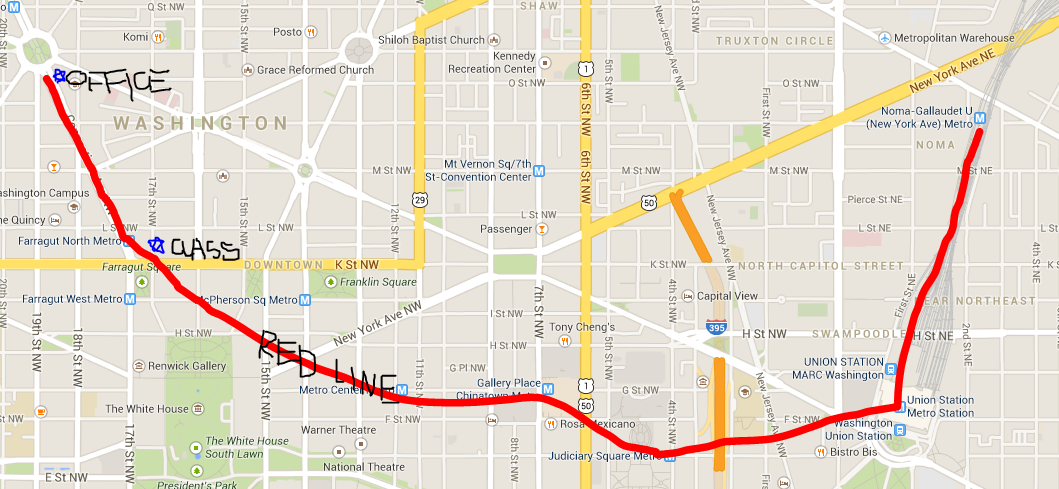
Back to the paragraph before that confusing story, we found a place that fit all our needs, and chose option number two, and currently live a half a block from the NoMa/Gallaudet U metro station on the red line. In the mornings, Dane gets off at Metro Center, Henry and Aman get off one stop later at the Farragut North station, and I get off one stop later at the DuPont Circle station, when I get off the escalator at the DuPont Circle stop, the door to my office is about 50 feet away, so I walk farther from mid quad to class at Kravis than I do during the entirety of my morning commute. Depending on the unpredictable combination of factors that dictates the speed of the red line, and whether the escalators are working or not, my commute can take anywhere from 15 to 25 minutes from the door of my apartment to my desk. CMC's suite is in turn about a 4 minute walk from my office, and a 2 minute walk from the Farragut North metro station. DC geography can be pretty confusing, although still not as confusing as our apartment complex, so here's a map.
Although public transportation is pretty decent, DC driving can be kinda rough, maybe not as bad as the city of LA or the state of New Jersey, but still inadvisable, especially for those unaccustomed to driving in a city. My next blog will discuss my job and some of the job finding process. Until then, here are some pictures from this past month.

Kids I work with visiting G Town
City Council Member and Mayoral Candidate Tommy Wells reading "Letter from a Birmingham Jail" at a Black History Month Celebration in a DC Public Library
Walk/snow ball fight back from an Indian food restaurant with Henry and Alana
Visit to the Corcoran Art Gallery's Question Bridge Exhibit with the non-profit I volunteer with
Fajitas I made for the boys a couple weeks back, kicked up with bold flavors

I wish I could attach some pictures of me asking His Holiness the Dalai Lama my question, but there was no photography allowed until after the event, check out Annie's blog/CMC website/His Holiness' facebook page for pictures of that.

Lucas Brooks
CMC '16

Monday, February 24, 2014

Change

So, I just finished Season 2 of House of Cards, and I am shocked, excited, and scared, all at the same time. I won't say anything, but aaaah Francis Underwood!!!!! It is pretty cool to be in Washington and recognize some of the places in the show. I wonder if Freddie's BBQ Joint actually exists…

But, like Frank Underwood, I, too, changed internships! Okay, I'll stop with the House of Cards references. My first internship wasn't a great fit for me, and it wasn't what I was looking for in my Washington experience. I'm now in the Office of Congresswoman Janice Hahn (D-44), and am so grateful to have been given a second chance and to work on the Hill. That being said, I learned that change is good, and sometimes necessary. Although I enjoyed my time at my previous internship and learned a lot, I'm glad I found the courage to switch internships. DC is full of transitions, and it's normal to change jobs. If you aren't happy or satisfied with your internship, feel free to speak up and talk to Dr. Spalding, or your internship coordinator, and figure out what the best course of action is for you.

Cannon House Office Building 
My place of work
I know I mentioned this in my previous post, but the use of public transportation and walking is so new to me! I've always used a car to get around everywhere in Los Angeles, and having to rely on public transportation is honestly not as convenient, and sometimes really frustrating, but I've learned to appreciate the nice morning walks, a few minutes to catch up on the news, and people-watching.

Rush hour crowd
Oh! The Washington Program students were invited to a town-hall discussion with His Holiness the Dalai Lama on Wednesday and Thursday, and he came over to where we were sitting!!!


The entire experience was amazing! He was such a humble and wise man. An We made it onto the official website (www.dalailama.com)!


Sunday, February 16, 2014

February 16, 2014

Welcome to the end of week three in DC! My name is Jessica Laird and I’m the final blogger for the Spring 2014 semester. I’m currently a junior at CMC, majoring in both Philosophy and Government. My internship this semester is with the White House in the Chief of Staff’s office.

So far the bloggers have been doing a great job of describing the program and providing some guidance on what to expect when you first arrive. They have, however, been failing to focus on one of the most basic things about living on your own (DC or anywhere) – food!

There are a few things to think about food-wise for your semester in DC. First, there is a plethora of amazing and diverse restaurants in the city and you should take the time to try new foods. Second, DC is also very expensive and you will most likely be on a tight budget. Third, between school and work the schedule here can be exhausting, so cooking or going out every night isn’t necessarily feasible. My experiences won’t apply to everyone, but I will share some tips I’ve learned so far.

The Amazing Restaurants

In the past decade, DC has really blossomed as a culinary destination. Because it is the national capitol and attracts visitors from all over the world, the city has an extensive international cuisine. I’m a huge fan of Chinese and Thai food, which works out well since my roommate, Sarah Owens, and I live in Chinatown. There are still so many great places I want to try; The Washington Post is a great resource for dining out with their “Going Out Guide.” Trying new places is also a great way to spend time with your classmates or fellow-interns.

Each weekend we have been going out to different restaurants as a group. Washington, DC is known for having really good Ethiopian food, so on the first weekend of the program a group of us went to Dukem in the U Street corridor.


Ethiopian food has a similar texture and common ingredients with Indian food. What is unique is that you don’t use utensils when you eat; instead, you use bread similar to a buckwheat pancake to scoop up your food.


The second week, we tried a new continent and went to Ping Pong Dim Sum in Chinatown. Unlike in a traditional dim sum house, at Ping Pong you order all dishes off of a menu and they have a full bar – it was very trendy.  The dumplings were still delicious, but everyone was a little surprised by the bill at the end of the night. It served as a good lesson for the future: even though a restaurant is well rated, you should check the prices on the menu before going there. I’ve made that mistake a couple of times now and I don’t plan on making it again.


Eating on a Budget

I have found that allotting $15/day is a reasonable way to budget my food expenses. This allows me to buy more than enough groceries each week and go out to eat once or twice on the weekends. Going out is definitely more expensive if you are 21 and choose to drink. I do, however, believe that it’s worth managing your spending throughout the week so you can afford to go out. DC has so many great bars and it’s a really social city. There are also tons of happy hour specials, which makes dining out and drinking very affordable if you want it to be. DChappyhours.com lists all the bars and restaurants with happy hour deals by neighborhood. 

Another way to save money on food while still being social is to have dinner parties or cook with your friends. Although I wouldn’t say cooking is my passion, I really enjoy food and trying new recipes. I am a vegetarian, so I like cooking for myself and making dishes to my preference. But cooking for a group often ends up being cheaper than dining out and leaves you with plenty of leftovers. Sarah and I both like to cook and we are lucky to live in the same building as Isabel, who is a culinary wizard. She often calls on us to be her baking experiment taste testers and we are more than happy to comply.


Sarah and I made guacamole and salsa and Henry made wings when we watched the Super Bowl at Aman, Lucas, Dane and Henry’s apartment.


Everyone made delicious dishes for a Valentine’s Day potluck at our apartment.


Eating During the Week

With a busy work schedule and a rigorous coarse load I am pretty tired every night and often don’t have the energy to cook dinner or go out. My solution, which has worked out well in terms of price and convenience, is to make a casserole or baked dish each weekend that can be reheated for dinner throughout the week. There are so many great recipes online and so many websites devoted to easy cooking. I can’t wait to try them throughout the semester! Did I mention I like to eat?


                               Mushroom, feta, kale and spinach frittata.


                  Potato, cauliflower, spinach, onion and mozzarella casserole (pre-bake).


This is not a meal, but I have become addicted to puppy chow.

Sunday, February 9, 2014

So, you think you want to be a Hill Intern?

Every semester on the Washington Program, there are usually at least one or two people that end up on the Hill. This is my second turn working in a House personal office, so I'm going to give a quick run-down of my experience. I've never worked in the Senate, so my perspective is limited there, but I've worked in both the majority and minority, in a freshman office, in a California office, during an off year and an election year, and as both a Summer intern and a Spring intern, and I've tried to summarize the similarities I've found in all of my experiences. Also, just so you know, working in a Committee office is completely different-- this post really only applies to personal offices.


Here's the quick and dirty:

What you'll be doing all day:

Administrative duties: manning the phones; sorting mail; stuffing envelopes; running errands; giving tours; making coffee; logging faxes; checking voicemails
Writing: constituent form letters; briefing summaries; basic research memos; floor summaries; leg updates; meeting prep

The good and the bad:

The benefits: getting to know well-connected staffers; access to information through all sorts of channels including: briefings, e-Dear Colleagues, CRS resources, mailings that come into the office, just sitting around listening to staffers chat; lots of free food; access to cool buildings like the Capitol and the Library of Congress
The drawbacks: long hours; you won't get paid; relying on other interns; you're seen as temporary and highly replaceable; you aren't allowed in staff meetings; there will either be too much or too little work; there's no guarantee you'll be exposed to your area of policy interest


And the longform:

The first thing to know about working on the Hill is that every office is completely different. While they generally use the same format and rely on the same services, each office has their own system for their internship program and general operations. My advice, as I've mentioned, is limited to my experience and many former Hill interns will have different and even conflicting experiences. Thus, the best thing you can do to anticipate what it will be like working in a particular Hill office is to speak to someone who has interned in that office before. Use CMC's resources, or if no one from Claremont has interned in that office before, LinkedIn searches will oftentimes turn you up a profile. Connect with them and ask them about their general takeaways, what their duties were like, how much exposure they got to actual policy vs. the photocopier, and where they are now. Regardless of what they tell you about their experience, chances are if they're now a staffer or a policy analyst at a think tank, their intern experience was probably a good one. If they never went back to Washington, you might want to take a look at some other offices.

That said, as I've described above, the general duties of an intern are pretty similar across the board. You'll spend a lot of time dealing with constituents. For most offices, interns are their first point of communication. You're the ones answering the phones, reading the mail, logging the petitions. You'll get intimately familiar with a software called "IQ," where most offices log all constituent correspondence. Most offices will also give you a chance to write some letters to constituents-- freshman offices more so, because many won't have go-to form letters written on every issue yet. Communicating with constituents exposes you to a wide array of issues, keeps you up-to-date on your news, and allows you to get in touch with the people that your office represents. While it can be dull and overwhelming at times, I've always valued how well I've gotten to know the American people by staffing the phones.

Additionally, a lot happens every day on the Hill. There are briefings, hearings, Congressional reports filter through the office. If you're in session, your member will be voting and holding meetings with various advocacy groups. There's no way the staff can keep track of it all, so they'll rely on you for attending many briefings (at many of which, there will be free food!). Also, some offices have interns do floor updates or legislative summaries of what happened the previous day, items that usually go out to all of the staffers and get added to the legislative records. This is a good way to keep up-to-date with the goings-on, get familiar with Congressional procedure, and have your writing read by everyone in the office.

Finally, you will absolutely be running a lot of errands and performing repetitive tasks. Especially in peak tourist season (Spring and Summer), you'll be leading a lot of Capitol tours. You will probably be making coffee at least once a day. You'll spend a lot of time stuffing envelopes. You can expect anywhere from three to six hours of your workday to be spent on tasks that you could have done as a high school freshman. It can be mundane, but your office relies on interns to do these tasks. If you weren't there, they wouldn't be able to function, and they'll thank you for it. Also, most of the staffers started in your shoes, so no one will look down on you.

Also, be warned: Hill hours are long. You should arrive at your office between 8 and 8:30, which usually means leaving your house no later than 7:30. You'll be expected to stay at least until 5:30 or 6, and on the nights you don't have class, you should be staying late. If you get a lunch hour, count yourself very lucky-- most Hill interns eat at their desks and continue to man the phones. And while your supervisors can be understanding if you have a big paper, you shouldn't count on having time to do homework at work.

All of that being said, working on the Hill is demanding, but can be very rewarding. You'll gain exposure to a variety of policy areas that you might never have otherwise noticed. The staffers, if you impress them, will always be willing to help you find a job, and most of them are very well-connected. Additionally, you'll have access to CRS reports and all of the reports that come in the mail to your office. It's more information than a hundred people could process in a lifetime. For some, that can be overwhelming. For others, it can be a dream come true. Make sure you know which type of person you are before you show up for your first day, and strategize to break down the data into manageable chunks so that you learn as much as possible.

Pitfalls I've encountered are few and far between, but can be lethal. The first office I worked in was with a very constituent-minded member. We sourced out a lot of work to our district offices, and our legislative work was minimal. If you're a policy nut, try to avoid offices like this. You'll end up with little work to do, and little exposure to your interest area. Try to find an office of a career politician, or a freshman that is on the Hill to make waves. Also, be wary of other interns; while many of them are wonderful, as with any office, their prior experience will vary. Occasionally, you may end up working on joint projects with interns who don't take their work as seriously as you do. This can be extraordinarily frustrating (but more advice on how to handle situations like that in my next post!).

The first time I went to Washington, I worked at a lobbying firm. Over the summer, I sat down with attorneys and policy advisers alike and asked them for advice on how to get started in Washington. Every single one of them told me, "go to the Hill for at least a summer, if not longer." Most anyone in Washington, whether they work in the public or private sector, view Hill experience as a 'must.' You end up with a decent idea of the policy-making process, plus you can make valuable connections that turn you into an asset for whatever entity you end up working for. While it perhaps isn't the most glamorous or interesting position, Washington is a meritocracy. Climbing the ladder can try your patience, but if you intend on staying in Washington for your career, you won't regret spending time on the Hill.

Still interested? You certainly aren't faint of heart

If you're still interested in working on the Hill, check out my next blog-- "How to be successful as a Hill intern." I'll be going over advice for the hiring process, how to make a good impression during your first week, and what makes you a stand-out intern in the long-term.

Sunday, February 2, 2014

Week 2- Lucas Brooks

I'm Lucas Brooks, CMC '16. I work for a consulting firm in DuPont Circle called Development Transformations, and my boss is actually a Pomona Grad and alumna of the CMC DC Program.
I live in the NoMa (North of Massachusetts Ave.) neighborhood of Northeast DC with Henry Appel, Aman Ghose, and Dane Brown, all '15 and all great guys. For anybody looking to come to DC this summer or in the future, our neighborhood is great. It's changing rapidly like a lot of DC, and our building in particular is really nice. There's an enormous supermarket on the ground floor which can be reached without ever having to go outside (convenient when it's below freezing outside), a half a block from a metro station and in walking distance of the Capitol. There are also two courtyards, a pool, two story gym, and even a dog park in the building.
The dining and kitchen area

The living room with my brand new 55" TV
One thing that's great about living here is that there are so many passionate, active people trying to fix the problems they see, so there's a lot of opportunity to get involved with the community. Besides my full time internship, I volunteer with an education focused non-profit in the city on Saturdays.
Two kids on our trip to the Smithsonian National Museum of Natural History.
 As someone from the West Coast, seeing a city react to snow is a fascinating experience. One of my favorite things I still can't get over is seeing the snow being blown upwards by the wind outside of the classroom's window last week.
View of Capitol from our apartment during SOTU


Dog in full snow suit
Have a great Super Bowl weekend everybody. One of the best things about being off campus for this semester is that, if the Seahawks win, I won't be in Claremont for the next four months of kids from Seattle gloating. Until next time, 

Monday, January 27, 2014

First Impression

Washington, DC: Week 1

City Night Lights
(Does anyone know what the name of this park is? Or how to get there???)

Day 1 of Orientation

"Hi, I'm Annie Hwang! I am a sophomore from Los Angeles, and am interning at 
The Dershowitz Group this semester." 
That was one of the first things Dr. Spalding taught us- how to introduce ourselves in DC. 
Because I'm not Madonna yet (and not in Cali anymore), I have to start using my last name in this formal, conservative town.


Our first day of Orientation Week ended early because DC panicked from the snow. Can you believe the federal government, and basically the whole town, shut down from like one inch of snow? 
And that I never saw snow before this week?! 
Like the North Pole! Get it? haha
Dane and Aman right before being attacked by Henry's snowballs
I was obviously super excited to see snow falling and thought it was the most beautiful thing ever… Until I discovered how painful and harsh Winter can be. 
In Los Angeles, Winter accessories don't exist. Nobody uses gloves, or owns earmuffs. I used scarves for the sole purpose of accessorizing my outfits. But, I have quickly learned that these are not Winter "accessories", rather necessities in this 10-20 degree weather. 
Bare hands vs. Winter
Please buy and use your gloves. 

 Day 2 of Orientation

Dr. Spalding got us tickets to tour the Newseum, easily my favorite part of Orientation Week. It was our first time bonding as a program, not to mention that this museum is amazing! 
If you have a chance, please go visit! 
Every day, the Newseum updates this wall with front pages from newspapers all around the world. 
Dane and Annie on the Newseum wall of fame
This doesn't belong in the Newseum gift shop!

Day 3 of Orientation

This was the longest day of the week, but the most memorable (with, of course, the exception of the Newseum). We toured the Capitol and had lunch with two CMC alumni who work on the Hill. 

Group Picture
Selfie with Jessica in front of the Capitol 
And then, we had this awkward hour and a half before our next meeting with Ben Miller, the Chief of Staff for Rep. Jared Huffman (D-CA). 
So, we decided to warm up at the U.S. Botanical Garden. And, it was beautiful.

Nature's colors
Thank you for teaching us so much about coffee! 
Sara and Ben checking the sugar content of water haha

Don't mind the height difference.
It was a long, long day with a lot of walking.
Lucas agrees. 

 Day 4 of Orientation

We had a private, backstage tour of the Supreme Court, followed by lunch at Professor Haskell's new job with Mike Franc, the Policy Director for the House Majority Whip. 

Majestic entrance

The Weekend Before the Start of our Internships

 My roommate Sarenna and I finally got our pots and pans in the mail, so we had to go grocery shopping! I promise there is fresh produce at the bottom of the cart; 
our last stop was just the frozen food section. 
A week's worth of food
My first night out in DC! 
Aman, Nick, Annie, and Henry
The Metro system gets easier!
Tip: buy a Smartrip card, make an online account for automatic payments to ensure that you never have to use those silly machines.
Subway Ride
I am finally settled into my apartment with everything unpacked, and the kitchen stocked. 
One thing that I learned and am so grateful for this experience is the independence. 
Finding my own apartment, signing the lease, shopping for apartment items, installing the Internet, and more, made me realize how difficult it is to live on my own. But, on the bright side, I learned my mistakes and know what to look for and what needs to be done for my next home (after the CMC dorms, of course). 

 And that concludes my first week in DC!